
The Positive Keyword Nightly Hunt is a strategic automation tool designed to scale your advertising efficiency. It works by scanning your search term reports every night for high-performing terms and automatically promoting them to targeted keywords or ASINs, ensuring you never miss a growth opportunity.
Accessing the Positive Nightly Hunt
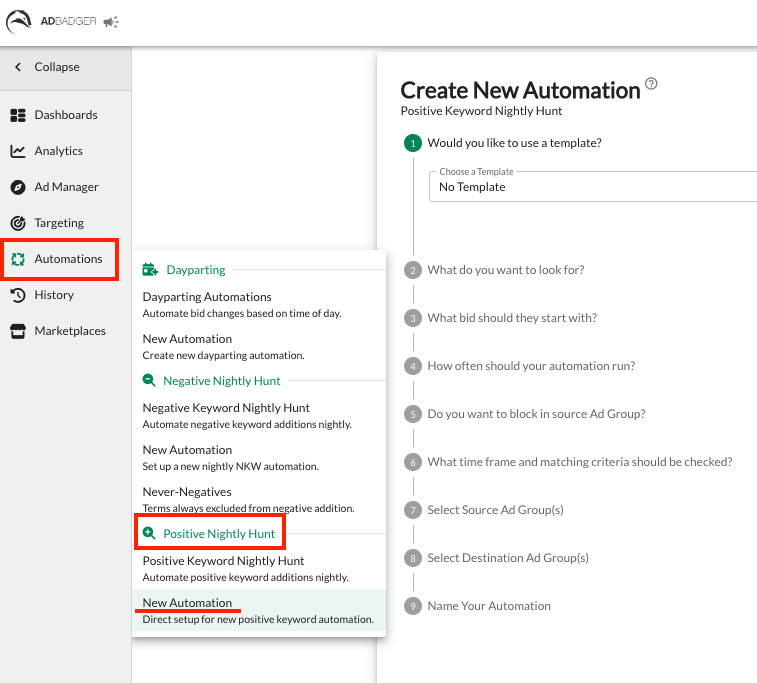
Navigate to the Automations tab in the left-hand sidebar
Select Positive Nightly Hunt from the dropdown menu
Click New Automation to begin setup
Creating Your Automation
When setting up a new Nightly Hunt, you have two ways to build your harvesting rules:
Option 1: Use a Pre-Filled Template
Ad Badger offers templates based on best practices to get you up and running quickly.
Using Templates for Faster Setup: Selecting a pre-filled template automatically configures your match types and bidding logic, allowing you to jump straight to the performance criteria: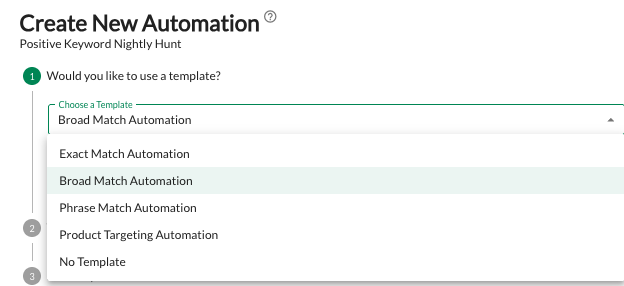
For Keyword Templates (Exact, Phrase, Broad): The system skips the initial setup and jumps you directly to Step 7 (Time Frame and Matching Criteria).
For the Product Targeting Template: Because there is no match type to select, the system jumps you straight to Step 6 (Time Frame and Matching Criteria).
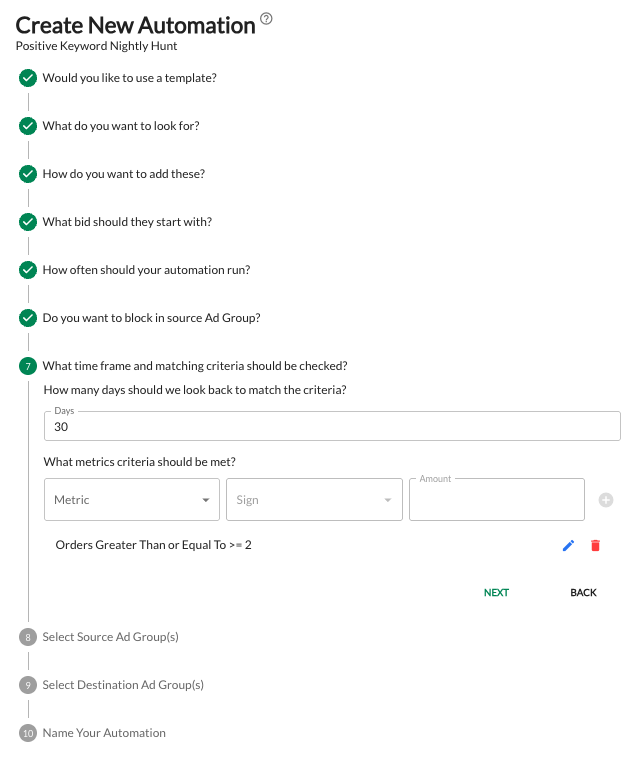
Pro Tip: Even though the template jumps you forward, you can always click the "Back" button to review or edit any of the pre-filled settings
Option 2: Create Custom Rules (No Template)
Select No Template to build your automation from scratch. A key decision happens at Step 2, where you choose what the "Hunt" is looking for. Depending on your choice, the workflow adapts:
A. Harvesting Keywords
If you select Keywords, the system will look for search terms to promote. You will see an additional step (Step 3: How do you want to add these?) where you must define the match type:
Broad
Phrase
Exact
B. Harvesting Targets (ASINs)
If you select Targets (ASINs), the system looks for specific product pages where your ads performed well.
Because ASINs do not use match types, the workflow is streamlined—skipping the match type selection and moving directly to bidding and frequency settings.
The Setup Process
Template Selection: Choose a pre-set or start from scratch.
Target Type: Choose between Keywords or Targets (ASINs).
Match Type (Keyword Only): Select Broad, Phrase, or Exact.
Starting Bid: Set how the system calculates the initial bid (e.g., Search Term Average CPC).
Frequency: Choose which days of the week the automation should run.
Block in Source: Decide if the term should be added as a negative in the original ad group to "funnel" traffic to the new target.
Lookback & Criteria: Define the performance window (e.g., last 30 days) and success metrics (e.g., Orders >= 2).
Source Ad Groups: Choose which ad groups to "hunt" in.
Destination Ad Groups: Choose where the successful terms should be added.
Name Your Automation: Give your rule a clear name for easy tracking.
Key Feature: The "Block" Logic
A powerful feature of the Positive Nightly Hunt is the ability to "block in source Ad Group." When enabled, the system adds the harvested search term as a negative keyword in the original ad group. This ensures that the traffic is "funneled" exclusively to your new, dedicated target where you have more control over the bid.
Why Use Positive Nightly Hunt?
Zero-Effort Scaling: Your keyword list grows automatically based on real customer data while you sleep.
Data-Driven Accuracy: Only bid on terms that have already proven they can convert.
Clean Account Structure: Automatically funnel performing terms from "Research" campaigns (like Autos or Broads) into "Performance" campaigns (Exacts).
Focused Optimization: Gain better control over individual bids for your top-performing search terms and ASINs.
Related Information
To learn more about negative keywords and how they affect your campaigns, check out our guide to search term graduation: https://www.adbadger.com/blog/amazon-ppc-keyword-research/
💬 Need Help?
Reach out to our Support Team anytime through the Live Chat bubble in the lower-right corner of the tool.